
Non-Comedogenic Tallow Skincare: Pore-Friendly Truth
-
By Igor Kapler
Introduction
“Will it clog my pores?”
That’s the first question most people ask when they hear about tallow skincare. And understandably so. If you’ve ever dealt with breakouts, congestion, or reactive skin, the idea of applying a rich, animal-based fat can feel counterintuitive.
At the same time, more people are moving away from overly complex routines and towards simpler, ingredient-led skincare. Tallow has re-emerged not as a trend, but as a return to something older — a form of skin nourishment that aligns more closely with how the skin actually functions.
So where does the truth lie?
Is tallow truly non-comedogenic — or is that just marketing language?
Let’s break it down properly.
What Does “Non-Comedogenic” Actually Mean?
Before understanding tallow, it’s important to understand the term itself.
A product is considered non-comedogenic if it is unlikely to clog pores and cause comedones — blackheads or whiteheads.
This is often measured using the comedogenic scale, which ranges from:
- 0 → Will not clog pores
- 1–2 → Low likelihood
- 3–5 → Moderate to high likelihood
Most ingredients labelled “non-comedogenic” fall within the 0–2 range.
Interestingly, beef tallow typically sits around 1–2 on this scale, depending on quality and formulation — placing it in the low-risk category for most skin types.
But this is where things get more nuanced.
Understanding Tallow in Skincare
Tallow is rendered fat, traditionally sourced from cattle, and used for centuries in skincare and soap-making.
What makes it unique is not just that it’s natural — but that it’s biologically familiar.
Its fatty acid profile closely resembles human sebum, the natural oil your skin produces.
This includes:
- Oleic acid
- Palmitic acid
- Stearic acid
Because of this similarity, tallow doesn’t sit on the skin as a foreign substance. Instead, it tends to integrate more naturally into the skin barrier.
This is one of the key reasons it behaves differently from many plant oils or synthetic ingredients.
Why the “Pore-Clogging” Debate Exists
If tallow is low on the comedogenic scale, why do some people still worry about it?
There are a few reasons.
1. The comedogenic scale is limited
The scale itself has limitations. It was originally based on tests using isolated ingredients — often not reflecting real-world formulations or human skin conditions.
That means it doesn’t always translate directly to how a finished product behaves.
2. Not all tallow is the same
Quality matters more than most people realise.
Poorly rendered, oxidised, or low-grade tallow can behave very differently from clean, properly prepared, pasture-raised tallow.
3. Skin type and usage matter
Even low-comedogenic ingredients can cause issues if:
- Applied in excess
- Layered with other heavy products
- Used on already congested skin
In other words, it’s rarely just about the ingredient — it’s about context.
Why Tallow Can Be Considered “Pore-Friendly”
Despite the confusion, there are strong reasons why many consider tallow to be skin-compatible rather than pore-clogging.
• It mimics natural skin oils
Because tallow closely matches sebum, the skin can recognise and use it more efficiently — rather than reacting to it as an imbalance.
• It supports the skin barrier
Healthy skin is less prone to congestion.
Tallow helps reinforce the lipid barrier, which can:
- Reduce water loss
- Improve resilience
- Support overall balance
• It doesn’t disrupt oil production
When the skin barrier is supported, the skin is less likely to overproduce oil — one of the key contributors to clogged pores.
Key Insights: What Actually Matters More Than “Non-Comedogenic”
Focusing only on whether something is “non-comedogenic” can be misleading.
Here’s what matters more in practice:
1. Ingredient quality
High-quality, well-rendered tallow behaves differently from low-grade versions.
2. Formulation simplicity
Fewer ingredients often mean less irritation and fewer variables.
3. Application amount
Tallow is dense. A small amount is usually enough.
4. Skin condition
Barrier-damaged skin may respond very differently compared to already oily or congested skin.
Common Myths About Tallow and Acne
“Tallow will clog all pores”
Not accurate.
Tallow is generally rated low on the comedogenic scale and is unlikely to clog pores for most people when used correctly.
“All oils are bad for acne-prone skin”
Oversimplified.
Some oils can trigger breakouts — but others, especially those closer to skin biology, may actually support balance.
“Occlusive = pore-clogging”
Incorrect.
Occlusives reduce water loss by forming a barrier. That doesn’t automatically mean they block pores.
Many widely accepted moisturisers are occlusive by design.
“Natural means non-comedogenic”
Also not true.
Natural ingredients vary widely. Coconut oil, for example, is natural — yet ranks high on the comedogenic scale.
How Tallow Applies in Real Life
So how does this translate into an actual skincare routine?
For dry or sensitive skin
Tallow can work as:
- A final step to seal moisture
- A barrier-supporting balm
- A minimal, low-irritation moisturiser
For combination skin
Best used:
- In small amounts
- Preferably at night
- On slightly damp skin
For acne-prone skin
Approach with awareness:
- Start slowly
- Use minimal quantity
- Monitor how your skin responds
For some, it may support barrier repair. For others, it may feel too rich.
Natural vs Modern Approaches
Modern skincare often focuses on:
- Lightweight textures
- Active ingredients
- Oil-free formulations
Traditional skincare focused more on:
- Barrier support
- Lipid nourishment
- Ingredient simplicity
Neither approach is inherently better.
But they serve different philosophies:
- One targets symptoms quickly
- The other supports long-term skin function
Tallow sits firmly in the second category.
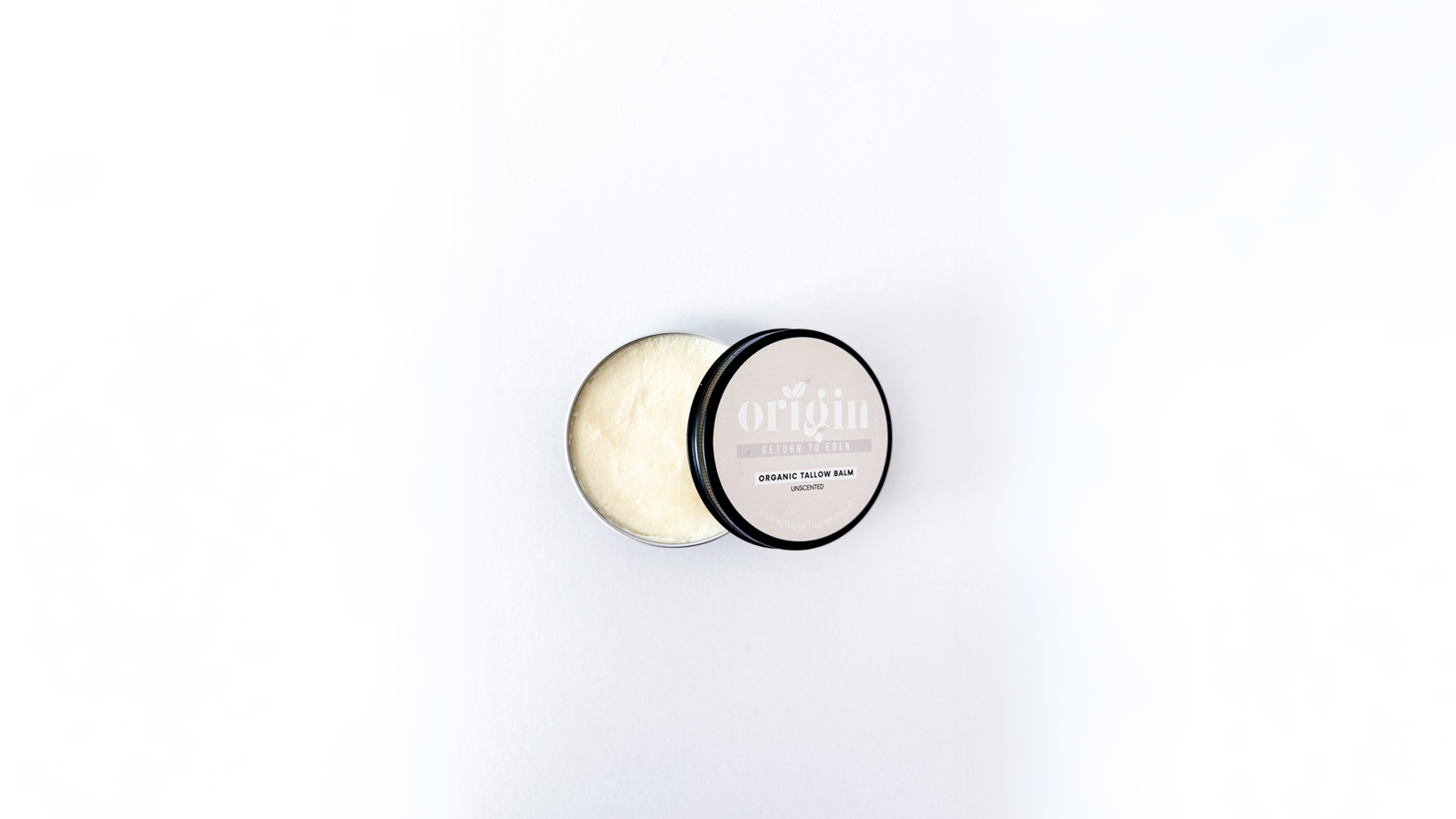
Product Consideration (Origin Approach)
At Origin, the focus is not just on tallow — but on how it’s sourced and prepared.
A well-formulated, unscented tallow balm may be suitable for:
- Sensitive skin
- Barrier repair routines
- Minimalist skincare approaches
Especially when:
- Free from unnecessary additives
- Made from high-quality, pasture-raised sources
- Properly rendered and stabilised
Frequently Asked Questions
Is tallow really non-comedogenic?
Tallow is generally considered low on the comedogenic scale (around 1–2), meaning it is unlikely to clog pores for most people — but individual results can vary.
Can tallow cause breakouts?
It can for some individuals, especially if:
- Used in excess
- Applied on already congested skin
- Low-quality tallow is used
Is tallow suitable for oily skin?
In small amounts, some people with oily skin tolerate it well. However, it may feel too rich for others.
Why does tallow feel different from other oils?
Because its fatty acid profile closely resembles human sebum, allowing it to integrate more naturally into the skin barrier.
Conclusion
The idea that skincare must be oil-free to be “safe” is slowly being questioned.
Tallow challenges that idea — not by being perfect, but by being biologically familiar.
It’s not about whether an ingredient is simply labelled non-comedogenic.
It’s about:
- How the skin recognises it
- How it supports the barrier
- How it’s used in real life
For many, tallow is not a pore-clogging risk — but a return to something simpler.
Not trend-driven.
Just skin, working with what it already understands.
Internal Links (Origin)
- The Science Behind Tallow’s Skin-Friendly Fatty Acids
- What Is the Process Behind Our Beef Tallow Balm?
- Beef Tallow Balm: The Natural Moisturiser Taking the UK by Storm